
24 November 2026
Share this article

Why insight into weight and material flows is becoming increasingly important

A container of scrap metal, a bin of wood offcuts or bales of plastic are easily seen simply as waste. But once these materials are sold, recycled or reused as raw materials, the perspective changes. A residual material stream can involve costs, but it can also represent economic value.

For companies that sell residual materials or pay to have them processed, knowing the quantity is therefore important. When materials are settled by kilogram or tonne, the measured weight and the agreed rate together determine the total amount a company receives or pays.

This is relevant not only to recycling and waste management companies. A window frame manufacturer having wood offcuts collected, a metalworking company selling scrap metal or a manufacturer dealing with plastic or cardboard waste can all benefit from better insight into their material flows.

When does waste have economic value?

Residual materials can have economic value when they can be reused as raw materials or sold. Whether a residual material stream actually generates revenue depends on factors such as the type of material, its quality, market demand and the agreements made for collection or processing.

Metal, for example, has a different market from wood, paper or plastic. Even within a single material category, factors such as quality, contamination and the degree of separation can make a difference.

Suppose a manufacturing company sells its scrap metal at an agreed rate per kilogram. The rate determines what each kilogram is worth, while weighing establishes how many kilograms are involved. The same principle applies to costs. If waste is processed at a rate per kilogram or tonne, the measured weight determines the quantity to which that rate is applied.

Why is insight into your own residual material streams important?

By weighing residual materials and recording the data over time, a company gains insight into how much material is lost, removed or sold. This makes developments visible that are difficult to identify without reliable information about quantities.

A single weighing shows how much material is being moved at a particular moment. The information becomes more valuable when data is collected structurally. For example, is the amount of wood waste increasing while production remains roughly the same? Is more metal scrap being generated at a particular stage of production? Or is a material stream larger than previously assumed?

Such developments can give companies a reason to take a closer look at what is happening within their processes. An increase in residual material does not automatically mean that something is wrong, but without information about the actual quantities, the development itself may remain unnoticed.

Weight data can also help put residual material streams into a broader business context. If a company knows how much material it purchases and how much eventually leaves the production process as a residual stream, it has a better factual basis for investigating material use, losses and potential areas for improvement.

The same data can also be useful when checking settlements with suppliers, buyers or waste processors. This does not have to be the main reason for weighing, but having your own data provides an independent record of the quantities involved.

Staff record details of bales of recyclable cardboard

How can you collect weight data without adding unnecessary process steps?

Weighing does not necessarily have to take place on a separate stationary scale. When materials are already being moved with a pallet truck or forklift, mobile weighing can make it possible to determine their weight during that movement.

This can be useful in environments where residual materials are handled regularly and where weight information needs to be captured without creating a separate weighing process each time. By integrating weighing into existing material handling, the weight can be recorded at the point where the material is already being handled.
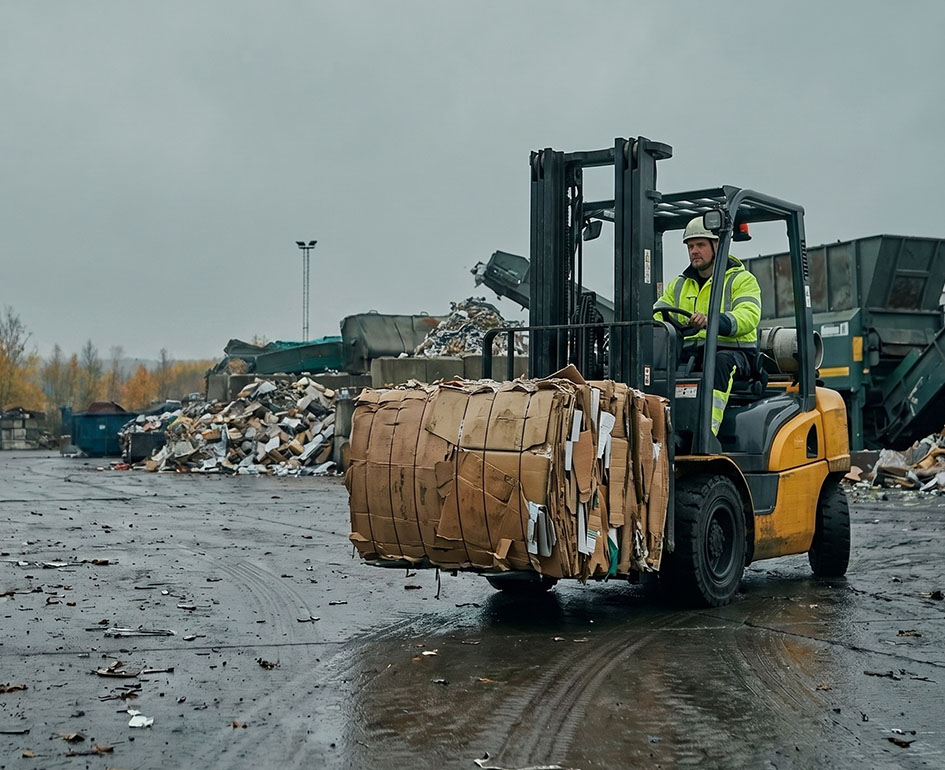
A forklift truck is moving a bale of cardboard at a recycling centre

When does a weight become usable weighing data?

A weight indicates how much a material flow weighs at a given moment. It becomes useful weighing data when it is clear what that measurement relates to, for example a type of material, date, customer, supplier, order or process step.

A single record of 820 kilograms tells us very little. If it refers to 820 kilograms of wood waste from a specific production period, then context is established. By systematically recording such data, quantities can be compared with one another and with other business data over a longer period.

Weighing data from RAVAS solutions can also be shared with business software, including ERP and WMS systems. In this way, a weight reading can become part of the existing flow of information within an organisation, rather than remaining merely a number on a display.

Insight into the material flows within your organisation

What do you put in your bin?

Would you like to gain a better understanding of the material flows within your organisation? Discover how RAVAS’s mobile weighing solutions and weighing data can benefit your process.

Aangepast Formaat Kenan Brandshoot